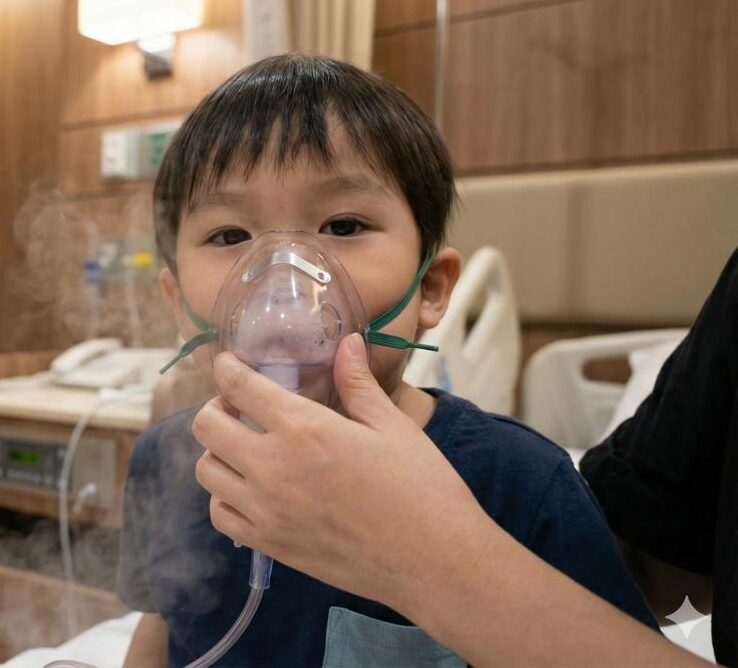
If you’ve ever rushed a child with breathing difficulties to an emergency room, you know the sound. It’s the loud, vibrating “Brrrrrr” of the electric nebulizer machine, a sound that, for many parents, signals that help has arrived and relief is on the way. It’s a common symbol of modern asthma treatment.
But what if that familiar procedure carries a hidden risk? What if the standard way of delivering that medicine could, in some cases, make a critical situation worse before it gets better? The surprising truth is that how a nebulizer is powered—with standard room air versus pure, medical-grade oxygen—can make a critical difference in your child’s safety and the speed of their recovery.
The Standard Nebulizer Can Secretly Lower Oxygen Levels
Here is the core paradox: a standard, air-driven nebulizer delivers medicine (a β2-agonist) that successfully opens up a child’s tight airways. However, that same medicine can inadvertently worsen a dangerous condition known as “ventilation-perfusion mismatch.” In simple terms, the drug can increase blood flow to parts of the lung that aren’t yet getting enough air. When blood rushes to areas with poor oxygen, the patient’s overall blood oxygen saturation can actually drop.
This effect is especially concerning for children who are already struggling with low oxygen levels (hypoxemia) from a severe asthma attack. Pushing room air (which is only 21% oxygen) through the nebulizer is often insufficient to counteract this effect. In fact, one clinical trial observed a significant drop in oxygen saturation of 3-5% in asthmatic children who received air-driven nebulizer treatments. For a child already in distress, this temporary but critical dip can be dangerous.
“…nebulization of β2-agonists without oxygen can cause or worsen hypoxemia.”
For Many Patients, Nebulizers Aren’t Even the First Choice
While nebulizers are a fixture in pediatric emergency care, it’s important to know that clinical guidelines often point to a different device as the preferred starting point for certain patients.
“The metered-dose inhaler with a spacer device should be the first choice for aerosolizing medications to the lower respiratory tract in cooperative adult patients.”
So why are nebulizers still so essential for young children? The answer is a matter of practicality and physiology. Most children under the age of five simply cannot perform the “respiratory gymnastics” needed to coordinate their breathing with a metered-dose inhaler (MDI). Furthermore, many anxious children may refuse the device, or they may be too sick and weak to generate the inspiratory pressure required to open the one-way valve on a spacer. In these common scenarios, the nebulizer remains the most effective tool for delivering life-saving medication.
The “Double Engine” Solution is Deceptively Simple
The solution to the risks of air-driven nebulization is both elegant and simple: use pure oxygen to power the nebulizer. Instead of an electric compressor that sucks in and pushes room air, this method connects the nebulizer kit directly to a medical oxygen supply. The pressure from the 100% pure oxygen flow creates the medicinal mist, delivering treatment and vital oxygen in a single breath.
Pediatrician Dr. Shravan Krishna Reddy calls this the “Double Engine” effect. The two engines work simultaneously to bring rapid relief:
* Engine 1 (The Medicine): Opens up the tight airways (bronchodilation).
* Engine 2 (The Oxygen): Simultaneously replenishes the body’s oxygen supply, relieving the “air hunger” and distress the child feels.
The practical benefits are often immediate. Care providers observe that babies and young children frequently stop crying and fall asleep within minutes of starting an oxygen-driven treatment. Their struggle ceases because their brain is finally getting the oxygen it was desperate for. An added benefit is that this method is silent, replacing the loud, intimidating noise of a compressor with calming quiet.
The Biggest Barrier Isn’t Technology, It’s Fear
If oxygen-driven nebulization is safer, faster, and quieter, why isn’t it the universal standard? The biggest hurdle may not be technology or cost, but a psychological barrier that Dr. Reddy terms “Cylinder Fear.” For many parents, the sight of an oxygen tank is instinctively associated with critical, life-threatening illness—a sign that a situation has escalated to an ICU-level condition.
This deep-seated fear can cause panic and prevent the adoption of what is ultimately a superior and safer method for routine asthma treatment. The key is to reframe what the oxygen represents in this context.
“In India, we have been conditioned to believe that an Oxygen Cylinder/Port = ICU Condition. We need to break this mindset.”
Using oxygen to power a nebulizer is not a sign that a child’s condition is failing. It is a sign that the clinical team is making a “smart” and “superior” choice to ensure a safer, faster, and more comfortable recovery.
A Question Worth Asking
The way a treatment is delivered can be just as important as the medicine itself. While the familiar electric nebulizer has helped countless children, a simple switch in its power source—from compressed air to pure oxygen—represents a significant leap forward in safety and effectiveness for kids in respiratory distress.
This knowledge empowers you to be a more informed advocate for your child’s health. The next time you see a nebulizer, you’ll know the most important question to ask isn’t just what medicine is inside it, but what’s pushing it.