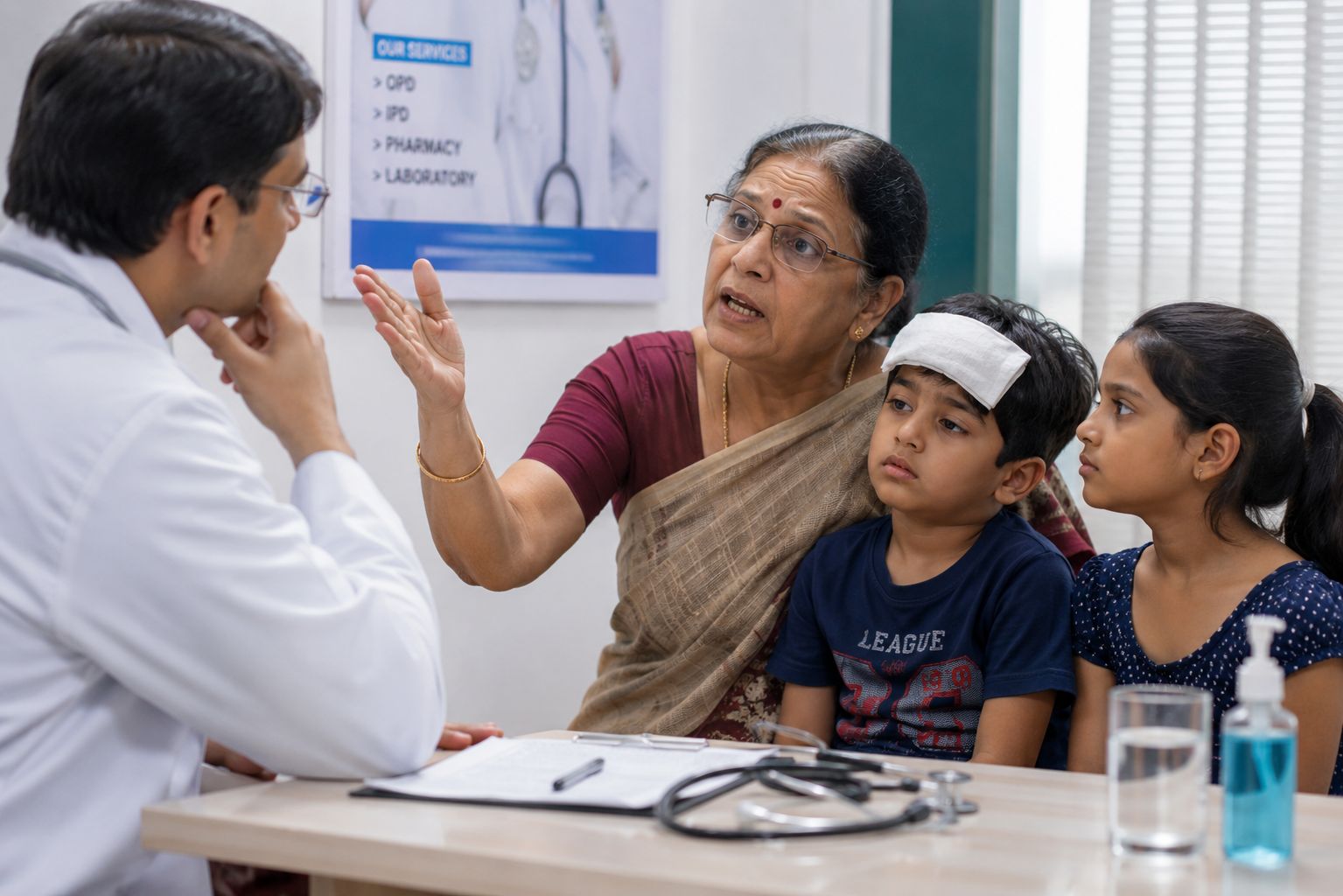
It is 4 PM in Tirupati. The waiting room smells of jasmine and sanitizer. A grandmother walks in holding a four-year-old boy by the wrist. Before she sits down, before I open his file, she has already delivered her diagnosis.
“Daktarugaru, vaadiki ushnam ekkuvayindi.”
The boy has heat. Too much heat. Inside his body.
I ask her why. She lists the evidence like a lawyer building a case. He has a rash on his neck. He had a mouth ulcer last week. He passed a hard motion two days ago. His palms feel warm. He gets cranky in the afternoon. His eyes look red after school.
All of it, she concludes, is heat.
I have heard this same speech a thousand times. From mothers, from grandmothers, from fathers who otherwise read the newspaper cover to cover. Every Indian household carries this one word in its pocket and pulls it out for everything it cannot explain. Ushnam. Vedi. Garmi. Heat.
Let me tell you what is actually happening inside that little body. Because once you understand it, you will never look at a rash, an ulcer, or a hard motion the same way again.
There is a beautiful idea passed down through generations that the human body works like a kitchen vessel. Eat the wrong food and heat builds up. Sit in the sun and heat builds up. Get angry and heat builds up. And then the body, having no other escape, throws this heat out as rashes, ulcers, pimples, red eyes, dry skin.
It is a poetic theory. It is also wrong.
Your body is not a vessel storing heat. Your body is a thermostat. A very strict, very precise thermostat. It runs at 36.5 to 37.2 degrees Celsius. Always. Whether you eat mango in May or wear a sweater in December. A part of your brain called the hypothalamus is the manager of this thermostat. Every second of your life, it reads signals from your skin, your blood, your muscles. Too warm? It opens the sweat glands. Blood rushes to the surface of the skin. You glow red. You sweat. Heat leaves through evaporation. Too cold? It tightens the blood vessels under the skin. You shiver. Muscles contract rapidly to make warmth. Fingers go pale. The body protects the heart and brain first.
This is not mysticism. This is engineering. And it works whether you eat a mango or a cucumber.
So what are all these things you call heat?
Let me walk you through the seven most common ones.
The rash on the neck is miliaria. Prickly heat. It happens when sweat ducts get blocked. The sweat cannot escape, so it pools just under the skin and breaks out as tiny red bumps. The cause is not internal heat. The cause is external humidity and friction. A cool bath, loose cotton clothes, a dry room. Two days. Done.
The mouth ulcer is usually a minor viral infection or a cheek bite or a deficiency of vitamin B and folate. Nothing to do with heat. Hydration, soft food, a vitamin-rich diet. Sometimes a topical gel.
The hard motion is constipation. In children it is almost always three things. Low water intake. Low fibre. Holding the urge because school toilets are dirty. The colon does not get hot. It gets dry and slow. Two glasses more water, fruits with skin, a regular toilet routine.
The warm palms are biology. Children have a higher metabolic rate than adults. Their hearts beat faster. Their bodies generate more heat per kilogram of weight. Warm palms after running around are not a disease.
The red eyes after school are allergy. Or dust. Or a low-grade conjunctivitis. Or screen fatigue. Saline drops, a clean pillow, less screen time.
The cold sore on the lip is herpes simplex virus. It lives quietly in the body and flares up during stress, illness, or sun exposure. It is a virus, not a furnace.
The afternoon crankiness is hunger. Or thirst. Or low sleep. Or the early hours of a viral infection. Children cannot explain what they feel, so they cry. The adult interprets the cry through the only word she knows. Heat.
When you collapse all seven of these into one word, you stop seeing them. You stop looking for the real cause. You stop fixing the right thing. You give the child coconut water and rose milk, and when the rash does not go away, you blame the heat for being stubborn. The rash was never about heat. The rash was about a blocked sweat duct.
Now hear me carefully. There is a real medical heat. It is not what your grandmother is talking about. It is much rarer and much more serious.
A child playing in 42-degree Tirupati afternoon sun without water for two hours can develop heat exhaustion. Pale skin. Heavy sweating. Nausea. Headache. Weakness. If ignored, it becomes heat stroke. Skin goes hot and dry. Sweating stops. Confusion sets in. Body temperature crosses 40 degrees. This is an emergency. This child needs immediate cooling and fluids. This is the heat doctors fear.
The other real heat is fever. Fever is when the hypothalamus deliberately raises the set point of your thermostat to fight an infection. The body is not failing. The body is fighting. A fever of 38 to 39 degrees in a child usually means the immune system is doing its job. You do not need to panic. You need to hydrate, observe, and treat the cause.
Heat stroke and fever are real. The rash, the ulcer, the hard motion, the warm palms are not heat.
The next time someone in your house picks up a child and announces that the body has too much heat, pause. Ask yourself which of the seven things on that list this actually is. Treat that one specific thing.
Stop pouring rose milk on a sweat duct problem. Stop giving cooling syrups for a viral ulcer. Stop blaming heat for what is really dehydration, allergy, infection, or simple biology.
Your child is not a pressure cooker. Your child is a thermostat. A precise, intelligent, self-correcting thermostat designed by millions of years of evolution.
Trust it. Understand it. Stop fighting an enemy that does not exist.
And the next time you walk into The Family Tree Hospital with the words “doctor, my child has too much heat,” I will smile, sit you down, and tell you the same story I just told you. Because the most powerful medicine I can give a parent is not a syrup. It is the truth about how the body actually works.
Dr. Shravan Krishna Reddy — MBBS, MD Pediatrics; Fellowship in Perinatal Medicine – Neonatology; Post Graduation in Pediatric Nutrition (Boston University, USA); APMC 73477
Co-Founder and Medical Director, The Family Tree Hospital, Tirupati