
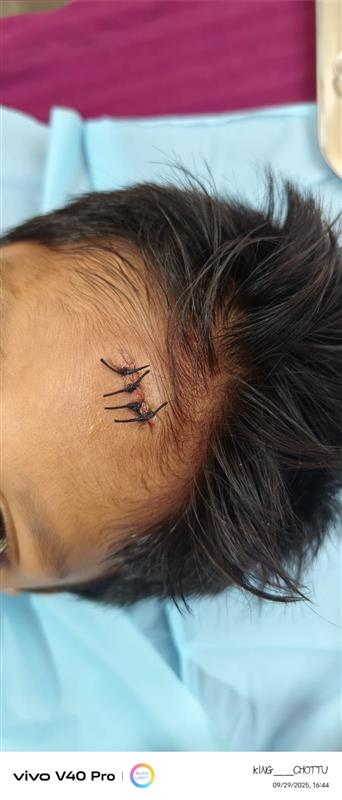
Last week, a mother walked into my OPD holding a 14-month-old boy. He had rolled off the family bed at midnight. He cried for two minutes, then fell asleep. She said, “Doctor, I thought he was fine.” He was fine — that time. But she had absolutely no idea which warning signs would have told her otherwise.
This conversation happens in my clinic every single week. And every single time, the injury was preventable.
01 — Why the Head Is Always the First to Fall
A child under three years has a disproportionately large, heavy head relative to their body. Their neck muscles are still developing. Their centre of gravity sits high — far higher than an adult’s. When they lose balance — from a bed, off a walker, through a cot gap, or over a balcony threshold — the head lands first. Every single time.
This is not a freak accident. This is predictable, preventable physics. And yet, we keep treating it as a surprise.
Most parents think danger comes from outside — from roads, strangers, and swimming pools. The data tells a completely different story. Approximately 70% of serious childhood injuries happen inside the home. Children between one and three years are in the highest-risk window. And nearly 90% of these incidents are preventable with simple, low-cost changes.
02 — The Hidden Danger Zones Inside Your Home
In Tirupati homes — where multi-floor constructions, open balconies, and low window ledges are part of everyday architecture — the risk is not abstract. It is structural.
Staircases and balconies are the first hazard to address. Safety guards must be installed across all staircase entries and balcony openings the moment your child begins to crawl. Balcony parapet walls must be tall and wide enough that a child cannot climb over them. Grill designs must not have horizontal members — a horizontal bar is a foothold, and a foothold is an invitation.
Upper-floor windows need attention the moment a child begins climbing. Lock them or protect them with grills or nets that allow a maximum opening of four inches. A gap that looks small to an adult is an exit point for a toddler’s head.
Baby cots are a category where most families unknowingly create risk. Bar spacing must be between 5 and 9.5 cm. A gap wider than 9.5 cm can trap a child’s head or allow the child to fall out entirely. The cot must stand at least 60 cm tall. The mattress must be firm. And the cot lock must not be openable by the child. Locally made wooden cots and borrowed second-hand furniture almost never meet these standards. If you cannot verify the measurements, replace the cot. It is a one-time cost against a lifetime of consequences.
Furniture should be sturdy and stable — a child must not be able to pull it down or tip it. Sharp corners on tables, chairs, and shelving units must be padded with corner protectors. Flat-screen televisions must be secured to the wall. Open or pulled-out drawers are a collision hazard — install drawer guards wherever possible.
“Parents come to me after the fall happens. But in almost every case, the injury was entirely preventable. The time to think about head safety is before the fall — not after it.”
— Dr. Shravan Krishna Reddy, Medical Director, The Family Tree Hospital, Tirupati
03 — The Baby Walker: A Hard Truth
Baby walkers can cause severe injuries and are not recommended. This is not a guideline from a foreign body. This is the official position of the Indian Academy of Pediatrics — the apex authority for pediatrics in India.
Children have rolled down staircases, tipped over floor thresholds, and struck their heads on hard surfaces and corners — all while strapped inside a walker. No brand, no design, and no price point makes a baby walker safe.
If you own one, remove it from use today.
The alternative is not complicated. Supervised floor time on a clean, flat, non-slippery surface is better for your child’s development and carries zero fall risk. Age-appropriate push-toys that a child walks behind — not inside — are a safe option. Most importantly, direct adult-assisted walking practice builds the coordination and balance that a walker actually prevents.
04 — Safe Sleep: The Rules That Save Lives
Safe sleep is the foundation of head injury prevention in infants. Babies who sleep on their backs are significantly less likely to die from Sudden Infant Death Syndrome (SIDS) than babies who sleep on their sides or stomachs. This single positional change saves lives.
Always place your baby on their back for every sleep period, day or night. Use a firm, flat sleep surface covered only by a properly fitted sheet. Keep your baby’s sleep area — whether a cot or bassinet — in the same room where you sleep until the baby is at least one year old. Placing the cot close to your bed means the baby is within view and reach at all times.
Keep soft bedding completely out of the sleep area. No pillows, no loose blankets, no stuffed toys. These increase the risk of suffocation and, in a startle response, can contribute to a fall.
Do not leave a phone charging near the cot or bed of the child. Keep the bathroom door bolted when stepping away briefly. When older children sleep on a raised bed, keep a cushioned mattress on the floor alongside the bed — this single step prevents a significant proportion of the head injury cases I see in my OPD.
05 — Your Child Has Fallen. Now What?
Not every fall requires an emergency visit. A child who knocks their head, cries briefly, and then returns to normal activity — playing, drinking fluids, recognising you — can usually be monitored at home for 24 hours.
But certain signs are non-negotiable. If you see any of the following, go to the hospital immediately. Do not wait for morning. Do not call a relative first.
Go to the hospital immediately if:
Your child loses consciousness — even briefly — after the fall
Seizure or jerking movements occur following a head injury
Your child vomits two or more times after the fall
Your child is unusually drowsy or very difficult to wake
The pupils are unequal, or the eyes drift or do not focus normally
There is a soft, bulging swelling on the skull — not a firm surface bump
Your child is under 12 months and has fallen from any height — always seek evaluation
Your child is inconsolable, crying unusually, or not recognising you
These are the signs of intracranial pressure changes, internal bleeding, or concussion — conditions that look quiet on the outside and move fast on the inside. No amount of home observation replaces a clinical assessment when these signs are present.
06 — Five Changes You Can Make Today, For Free
The changes that matter most do not require a renovation. They require awareness and ten minutes of your time.
First, pad every sharp furniture corner in your home with corner protectors. These are available at any hardware store in Tirupati for under Rs. 200. Second, place a cushioned mattress on the floor alongside your child’s bed every night — it takes thirty seconds and eliminates the risk of a hard-surface fall. Third, install a sensor light or leave a hall light on through the night. A disoriented child walking in the dark walks into walls and falls off raised surfaces far more often than parents realise. Fourth, remove the baby walker from use — permanently. Fifth, wall-mount your flat-screen television today. A pulled-down TV is one of the most common causes of serious head injury in toddlers.
None of these cost much. All of them matter.
A Final Word
Every time I discharge a family with a newborn or toddler, I say the same thing: your home was not designed for a child. You have to redesign it — not expensively, but intentionally.
All parents should know basic CPR and first aid before an emergency arrives. Be aware of hospitals near your residence that run round-the-clock emergency services for children. Have the number ready before you need it.
The Family Tree Hospital’s Pediatric Emergency is available 24 hours, seven days a week. If your child has had a fall and you are not sure whether they need evaluation, WhatsApp us at 8186883388. Do not wait and hope.
For ongoing access to our clinical team — personalised guidance, priority emergency support, and real answers from our specialists — explore The Family Tree Circle™ at www.thefamilytreehospital.com.
-
- Tags: Child Safety · Head Injuries · IAP Guidelines · Tirupati Pediatrics · Home Safety · Baby Care · Safe Sleep · Parenting
© 2026 The Family Tree Hospital, Tirupati. This article is for educational purposes only and does not substitute clinical consultation.
- Tags: Child Safety · Head Injuries · IAP Guidelines · Tirupati Pediatrics · Home Safety · Baby Care · Safe Sleep · Parenting